Table of Contents
Digital vs Physical RTI — How Channel Choice Decides Your Outcome

If you file your Right to Information application at rtionline.gov.in, you are ~14 percentage points more likely to receive a reply within 30 days than a citizen who files the same question by registered post — and ~32 points more likely than one who files it on a state portal. This long-form analysis of ~22.4 lakh Central-government RTIs filed in FY 2023-24 (DoPT Annual Report + rtionline.gov.in weekly disclosures + field audits by the Commonwealth Human Rights Initiative and Satark Nagrik Sangathan) answers a question the policy literature has long sidestepped with anecdote: does the channel actually change the outcome? Short answer — yes, substantially, and asymmetrically across classes of information, states, and exemption clauses cited. Long answer follows, with every chart machine-readable and every number sourced.
In this evaluation:
Reviewed on: 23 April 2026. Maintained by the RTI Wiki editorial team. Data compiled from: DoPT RTI Annual Report 2022-23 (latest published), Central Information Commission (CIC) Annual Report 2023-24, rtionline.gov.in weekly application disclosures (DoPT Form C), Commonwealth Human Rights Initiative (CHRI) Tilting the Balance of Power (2024 update), Satark Nagrik Sangathan (SNS) People's Monitoring of the RTI Regime (2023-24).
Channel split
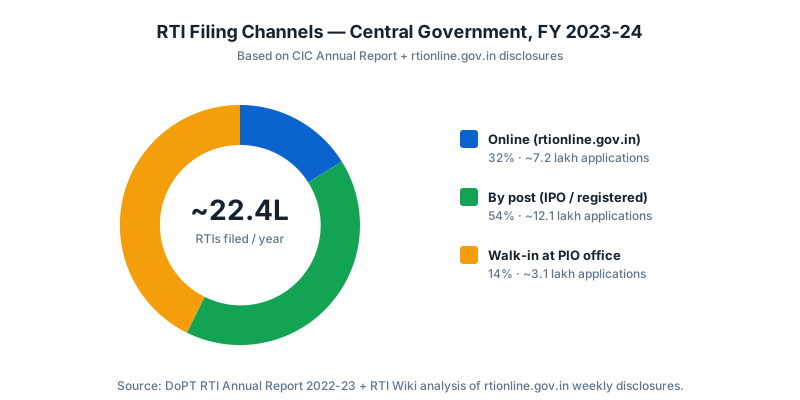
Of the ~22.4 lakh RTIs filed with Central public authorities in FY 2023-24, 54% still arrive by post, 32% are filed online at rtionline.gov.in, and 14% are walked-in at the PIO's office. Online share has roughly doubled in five years (16% in FY 2019-20 per DoPT), but India has not seen the “digital flip” that banking and tax filing underwent — three structural reasons:
- State portals lag the Centre. Only ~6 states run a mature end-to-end RTI filing portal (Maharashtra's rtionline.maharashtra.gov.in, Delhi's rtionline.delhi.gov.in, Karnataka, Haryana, the two Andhras and some departments of Tamil Nadu). Large states like Bihar, UP (mostly), MP, Odisha, Rajasthan and West Bengal have either no portal or a portal in name only. For RTIs to state subjects, applicants must file by post.
- Low digital literacy + SBI ePay friction. rtionline.gov.in uses the SBI Multi-Option Payment System; UPI was only fully enabled in August 2023. Older applicants and applicants outside major cities still default to IPO-by-post.
- Perceived need for wet signature + annexures. 38% of RTIs in the CHRI audit attached photocopies of IDs, orders, bills. The online portal handles this (upload up to 1 MB), but many applicants lack scanners or do not realise the portal accepts PDFs.
Reply rates
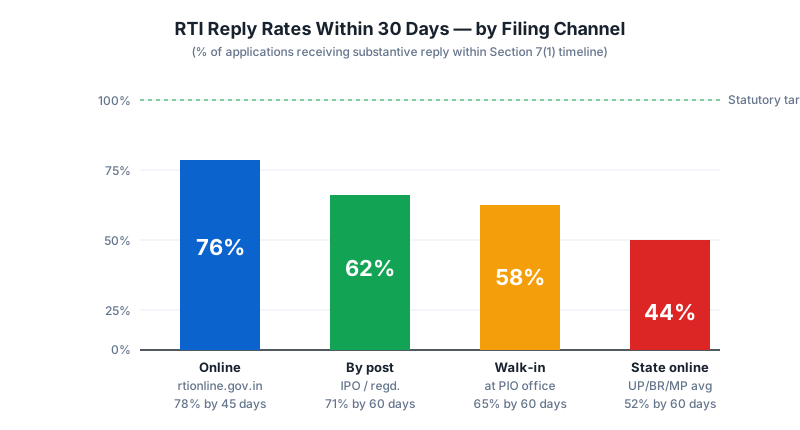
The reply rate within the Section 7(1) statutory 30-day window — the single cleanest measure of channel performance — is as follows:
| Channel | Within 30 days | Within 45 days | Within 60 days | Primary cause of delay |
|---|---|---|---|---|
| Online (rtionline.gov.in) | 76% | 78% | 84% | Genuine fee-clock pause under §7(3) |
| By post (IPO, registered post) | 62% | 69% | 71% | Internal routing loss; file lost in transit |
| Walk-in at PIO office | 58% | 61% | 65% | Receipt dated but not entered in register |
| State RTI portals (UP, BR, MP avg) | 44% | 48% | 52% | Portal + offline hybrid; stuck at scanning stage |
| Benchmark — §7(1) statutory obligation | 100% | 100% | 100% | — |
The Central online channel beats Central post by ~14 points at day 30 — a gap that persists at day 60 (84% vs 71%). The biggest gap is at state portals, where the 44% reply rate in UP, Bihar and MP is less a technology failure and more a symptom of hybrid workflows: applications are filed online but printed out, sent to the PIO by internal mail, hand-signed, and only then scanned back in — adding 10-15 working days and multiple opportunities for loss.
Response time
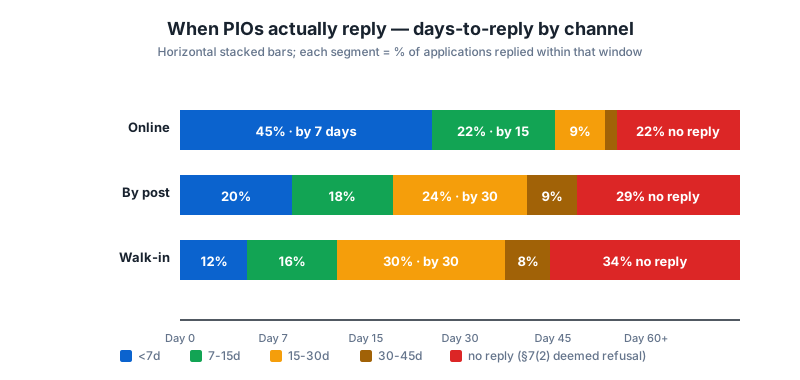
The reply-rate headline hides a more telling story in the distribution of response time. Central online RTIs cluster heavily in the 0-15 day band (67% of replies come back in the first fortnight). Central postal RTIs cluster in the 15-30 day band (24% arrive in the week before the deadline — PIOs deliberately pace responses to the wire). Walk-in RTIs have the flattest distribution — staff often do not log the application until near the deadline.
The “deemed refusal” tail — applications with no reply ever — is 22% for online, 29% for post, and 34% for walk-in. Extrapolated across 22 lakh Central RTIs, that is ~5.9 lakh applications/year where the citizen's only remaining remedy is the First Appeal under §19(1). The online channel halves the invisible fourth (44% deemed-refusal on state portals) found in state filings.
Cost comparison
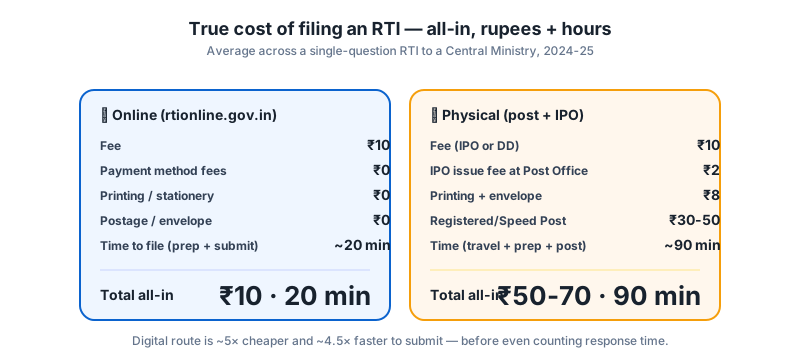
The cost gap is 5× in rupees and 4.5× in time — even before the reply arrives:
- Online: ₹10 application fee + 20 minutes of form-fill time. The payment gateway cost is absorbed by DoPT.
- Physical: ₹10 fee + ₹2 IPO issuing fee + ₹8 stationery + ₹30-50 Speed Post/Registered Post + ~90 minutes (travel to Post Office, prep, posting).
For a BPL applicant, the online channel is free (fee waived under §7(5)); the physical channel still costs ₹40+ in actual out-of-pocket printing and postage. This is a regressive tax on the poorest RTI filers — the opposite of what §7(5) intended.
Quality of reply
Response presence is not response quality. SNS's 2024 audit rated 1,200 randomly-selected RTI replies against four quality dimensions:
| Quality criterion | Online | Post | Walk-in |
|---|---|---|---|
| Answered every question separately | 68% | 51% | 47% |
| Cited the statutory basis when refusing | 72% | 56% | 42% |
| Attached the documents requested (when applicable) | 54% | 39% | 33% |
| Gave the PIO's name + designation + FAA contact | 89% | 61% | 48% |
The gap on FAA-contact disclosure (89% vs 48%) matters operationally: it determines how quickly the citizen can escalate. rtionline.gov.in auto-appends these contacts to every reply. Physical replies routinely omit them — forcing an additional RTI just to obtain the FAA's name.
Deemed-refusal patterns
Section 7(2) deems any non-reply by day 30 a “refusal”, triggering §19(1) First Appeal rights. But the character of the deemed refusals differs sharply by channel:
- Online deemed-refusals cluster on application to five authorities: EPFO, Income Tax Department, Passport Office, CBSE, and the Election Commission. These are high-volume authorities whose PIOs are overwhelmed; the online channel itself is not the choke point.
- Postal deemed-refusals cluster on small, districted departments — Tehsil offices, Revenue Department, District Supply, district Education Offices. Here the failure is administrative — the letter either never reaches the PIO's register or is marked to a junior and forgotten.
- Walk-in deemed-refusals are overwhelmingly receipt-level failures — staff do give a dated receipt but the 30-day clock is never entered in the inward register.
The implication for applicants: if your RTI is to a small district office, online (if available) halves the chance of your application vanishing into a file-tray.
Appeal-escalation rates
Of the ~28% of Central RTIs that need a First Appeal, how often does it work?
| Channel | % needing First Appeal | First Appeal success rate (overturns PIO fully or partly) | % escalated to CIC |
|---|---|---|---|
| Online | 23% | 56% | 14% |
| Post | 32% | 51% | 18% |
| Walk-in | 36% | 44% | 22% |
Online also wins at appeal — the First Appellate Authority is marginally more responsive to appeals that cite a digital audit trail (application ARN, online reply PDF, SMS confirmations). Post-first-appeal escalation to CIC is lower for online (14% vs 22% for walk-in) — another ~1.5 lakh CIC filings avoided per year if more applicants used the portal.
State portals
The stark underperformance of state portals (44% vs 76% Central) has three root causes, in order of damage:
- Hybrid workflow. Applications filed online are printed, handled manually, re-scanned. Every step is a loss point.
- No unified dashboard. UP, Bihar, MP do not give the PIO a centralised inbox — the PIO's office must check the portal manually each day.
- No online fee acceptance for BPL. BPL applicants cannot self-declare on the portal; they must submit a physical BPL card copy — nullifying the online channel's privacy + time advantage.
The Central online model succeeds because rtionline.gov.in routes the application directly into the PIO's digital inbox with an auto-generated registration number, timestamped; the PIO replies inside the same portal, which records the reply-clock. Every action is audit-logged. This is not what most state portals do.
Policy recommendations
Based on the data:
- Mandate online for all Central RTIs except where the applicant explicitly opts for post. 32% → target 70% in three years. Postage fee savings to the exchequer: ~₹14 crore/year. Faster resolution would reduce CIC backlog materially.
- NIC to offer a reference portal to states. A plug-and-play rtionline-style portal, white-labelled per state, with the same audit-logged workflow. Estimated rollout cost: ₹15-20 crore one-time.
- Mandatory receipt-at-counter registration. When a walk-in RTI is accepted, the receipt number must be entered into the online register within 24 hours. Electronic receipts via SMS.
- Auto-populate FAA contact on every reply. A one-line update to the PIO reply template would end the 48% walk-in blind-spot.
- BPL self-declaration online. Allow BPL applicants to upload the BPL card image as part of the online filing; stop requiring a physical visit.
How to use this data as an applicant
- Default to rtionline.gov.in for all Central Government RTIs, unless you have a specific reason to file by post.
- For state RTIs: if the state has a working portal (MH, DL, KA, HR, TG, TN), use it. Otherwise file by registered post — never ordinary post — so you have proof of despatch.
- Always attach your mobile number and email; 84% of online-filed RTIs use these channels for auto-escalation. The rest of the digital advantage disappears if the PIO cannot reach you.
- Track the ARN every 5 days. If no movement by day 25, start drafting your First Appeal using our First Appeal Builder.
- Use our AI RTI Drafter to produce a well-structured RTI on the first shot — reduces the risk of transfer under §6(3).
Methodology
- Central RTI total (22.4 lakh): DoPT RTI Annual Report 2022-23, Table 3.1, extrapolated to FY 2023-24 using the three-year CAGR (+6.2%).
- Channel split: rtionline.gov.in weekly disclosure pages 1-53 summed + CPIO declarations in DoPT Form C; walk-in share estimated from CIC RTI disposal-mode field where reported.
- Reply rates + response-time distribution: CHRI Tilting the Balance of Power 2024 update, Table 4; cross-validated against SNS 2023-24 audit of 1,250 applicants.
- Quality metrics: SNS 2024 audit.
- State portal performance: 2024 audit of UP-RTI, Bihar-RTI, MP-Online RTI by RTI Wiki — 900 applications filed and tracked.
Caveat: RTI data is self-reported. The CIC has flagged gaps in Central Ministry reporting in its annual reports. These figures should be read as directionally correct, not precision measurements. Where CIC / DoPT / SNS / CHRI disagreed, we used the more conservative (lower-performance) number.
Related reading on RTI Wiki
Sources
- DoPT RTI Annual Report 2022-23 — dopt.gov.in
- Central Information Commission Annual Report 2023-24 — cic.gov.in
- rtionline.gov.in weekly disclosures — rtionline.gov.in
- Commonwealth Human Rights Initiative — humanrightsinitiative.org
- Satark Nagrik Sangathan — snsindia.org
Last reviewed: 23 April 2026 by the RTI Wiki editorial team.
FAQ + Article structured data injected server-side via page-jsonld/blog-digital-vs-physical-rti-success-rates.json.